
Make Breizh & Ryukyu your preferred source on Google
Get our newest Okinawa stories, travel tips and itineraries featured directly in your search results.
Countless international visitors make the exact same mistake upon landing at Naha Airport (OKA): they stand in a 90-minute shuttle line to pick up a rental car, drive straight onto Highway 58 toward west-coast resort hotels, and never look back at the capital. Doing so means skipping the cultural soul of the ancient Ryukyu Kingdom.
Far from being a concrete administrative port of 320,000 residents, Naha (那覇) is a layered, walkable island city where UNESCO-listed royal citadels, 16th-century coral limestone lanes, 340-year-old pottery kilns, tropical fish halls, and retro post-war tavern alleys coexist within a few monorail stops.
Better yet, Naha is the only part of Okinawa best explored 100% car-free. Living in Okinawa since 2018 and guiding travelers across the island, I have designed this complete 1 or 2-day Naha playbook to help you connect royal history, backstreet craftsmanship, and authentic local nightlife without ever worrying about traffic or parking.
- Skip the Rental Car in Naha: The elevated Yui Rail monorail (17 km, 19 stations) connects Naha Airport to Shuri Castle in 27 minutes. A 24h Pass (800 JPY / ~$5.30 USD) or 48h Pass (1,400 JPY / ~$9.30 USD) pays for itself by ride three and saves 1,500 to 2,500 JPY/night in hotel parking fees.
- Day 1 (Essential Heritage & Nightlife): Morning on the royal hilltop of Shuri (Shuri Castle 400 JPY, Kinjo-cho stone path), lunch at Makishi Public Market, afternoon with the ceramic masters of Tsuboya (founded in 1682), and evening izakaya hopping in Sakaemachi Market.
- Day 2 (Secret Royal Gardens & Coast): Peaceful morning at UNESCO-listed Shikina-en Royal Garden (400 JPY), midday at cliffside Naminoue Shrine and Fukushuen Garden (200 JPY), afternoon at the Okinawa Prefectural Museum (OkiMu) or sunset over the lagoon at Senagajima.
- Golden Dining Rule: Avoid tourist-trap steak and souvenir restaurants on Kokusai-dori; walk two blocks into the backstreets of Sakaemachi (Asato Station) or Ukishima-dori for genuine Ryukyu home cooking.
Why Spend 1 or 2 Days in Naha Without a Car?
In 2026, the Okinawa Urban Monorail (Yui Rail) carries more than 20 million passengers annually along its 17-kilometer elevated track linking Naha Airport to Tedako-Uranishi (Okinawa Urban Monorail Inc., 2025-2026 operating report). Every major cultural landmark in Naha sits within a 5 to 15-minute walk of a monorail station.
From a practical standpoint, I always recommend placing your 1 or 2 days in Naha either at the very beginning or the very end of your Okinawa itinerary:
- At the start of your trip: After flying in from Tokyo, Osaka, Taipei, or Singapore, you step directly from the terminal into Naha Airport Monorail Station and reach downtown (Kencho-mae or Makishi) in 11 to 16 minutes for 270 to 300 JPY. You bypass the airport car rental shuttle queues entirely and pick up your car from a downtown agency (such as Omoromachi T Galleria) 24 or 48 hours later.
- At the end of your trip: You return your rental car a day or two before your flight out, save 1 to 2 days of car rental and urban hotel parking charges, shop for fragile Yachimun ceramics and aged Awamori bottles on foot, and ride the monorail to your departure gate with zero highway traffic risk.
(To master this time-saving pickup trick, read our complete Okinawa car rental agencies & airport traps guide as well as our playbook on visiting Okinawa without a car.)
Naha at a Glance: Comparing the 6 Key Neighborhoods
Across Naha's 39 square kilometers, cultural sights cluster into 6 distinct neighborhoods connected by the Yui Rail monorail (Naha City Tourism Database, 2026). Understanding how they fit together lets you explore without backtracking.
| District / Area | Yui Rail Stop | Ideal Time | Vibe & Highlights | Arnaud's Local Tip |
|---|---|---|---|---|
| 1. Shuri (Royal Citadel) | Shuri / Gibo | 3h00 - 4h00 | Ryukyu royal palace, UNESCO Tamaudun mausoleum, Kinjo-cho stone path. | Walk downhill along the 1522 Kinjo-cho limestone path instead of retracing your steps. |
| 2. Tsuboya (Potters) | Makishi / Asato | 1h30 - 2h00 | 340-year-old ceramic village, wood-fired climbing kilns, Shisa guardians. | Slip off main Yachimun-dori into the narrow southern Suujigwa alleys. |
| 3. Makishi & Arcades | Makishi / Kencho-mae | 2h00 - 3h00 | Tropical fish market, 3 km of covered Shotengai arcades, craft shops. | Skip noisy Kokusai-dori for bohemian Ukishima-dori and Heiwa-dori alleys. |
| 4. Sakaemachi (Evening) | Asato (2 min walk) | 2h30 - 3h30 (night) | 1950s covered market maze with 100+ tiny local izakayas and Sanshin music. | Arrive around 19:00 when red lanterns glow and local regulars fill the stools. |
| 5. Naminoue & Kume | Asahibashi / Kencho-mae | 2h00 - 2h30 | Shinto shrine perched on a coral cliff and classical Fukushuen Chinese Garden. | Fukushuen stays open until 21:00 with atmospheric evening illumination (300 JPY). |
| 6. Omoromachi (OkiMu) | Omoromachi | 2h00 | Okinawa Prefectural Museum & Art Museum, modern shopping hub. | Your best midday refuge from intense subtropical heat or sudden rain. |
Day 1 in Naha: Royal Shuri, Tsuboya Potters & Sakaemachi Izakayas
In 2026, a Yui Rail 24-Hour Pass costs 800 JPY (~$5.30 USD) and a 48-Hour Pass costs 1,400 JPY (~$9.30 USD), valid for a full 24 or 48 hours from the exact minute of purchase and granting a 20% admission discount at Naha's major museums and royal sites (Okinawa Urban Monorail Inc., 2026). Buy yours at the ticket machine in the morning and ride straight up to Station 15 (Shuri).
1. Morning (09:00 - 12:15): Shuri Castle, Tamaudun & the Kinjo-cho Cobblestone Path
For 450 years (from 1429 until Japan annexed the archipelago in 1879), the hilltop citadel of Shuri Castle (Shurijo) served as the royal court and spiritual heart of the Ryukyu Kingdom. Here is the exact walking loop I use to avoid tour bus crowds:
- Shureimon Gate & Sonohyan-utaki Stone Gate (09:00): Walk 12 minutes from Shuri Station (or take local Bus #8 for 4 minutes) to pass beneath the 16th-century vermilion Shureimon Gate. Immediately to your left stands Sonohyan-utaki Ishimon (built in 1519 and inscribed as a UNESCO World Heritage site), the sacred coral-limestone shrine where Ryukyu kings prayed for safe maritime voyages.
- The Seiden "Living Reconstruction" Pavilion (09:45): Paid zone admission is 400 JPY (320 JPY with your Yui Rail Pass). Following the October 2019 fire, the reconstruction of the Seiden main hall (set for completion in autumn 2026) was turned into an extraordinary three-story glass-walled workshop. You stand just meters away from master carpenters carving sacred Hinoki cypress beams and applying cinnabar red lacquer.
- Tamaudun Royal Mausoleum (10:45): Just a 3-minute walk west of Shureimon, this massive carved-limestone royal tomb built in 1501 (UNESCO World Heritage site, 300 JPY or 240 JPY with Yui Rail Pass) is surprisingly quiet because big tour groups skip it.
- Secret Downhill Walk via Kinjo-cho Stone-Paved Path (11:15): Do not exit via the bus parking lot! Walk down Shuri Kinjo-cho Ishidatami-michi, a 300-meter coral cobblestone road laid in 1522 under King Sho Shin. Flanked by mossy stone walls, red-tiled houses, and 6 sacred 300-year-old Akagi (bishopwood) trees, it is the most atmospheric lane in Naha.
2. Early Afternoon (13:30 - 15:30): Tsuboya Pottery District (Yachimun-dori)
After a comforting bowl of slow-simmered Okinawa Soba (850 to 1,100 JPY) near Shuri, ride the Yui Rail 10 minutes down to Makishi Station (or Asato Station) and walk into Tsuboya (壺屋).
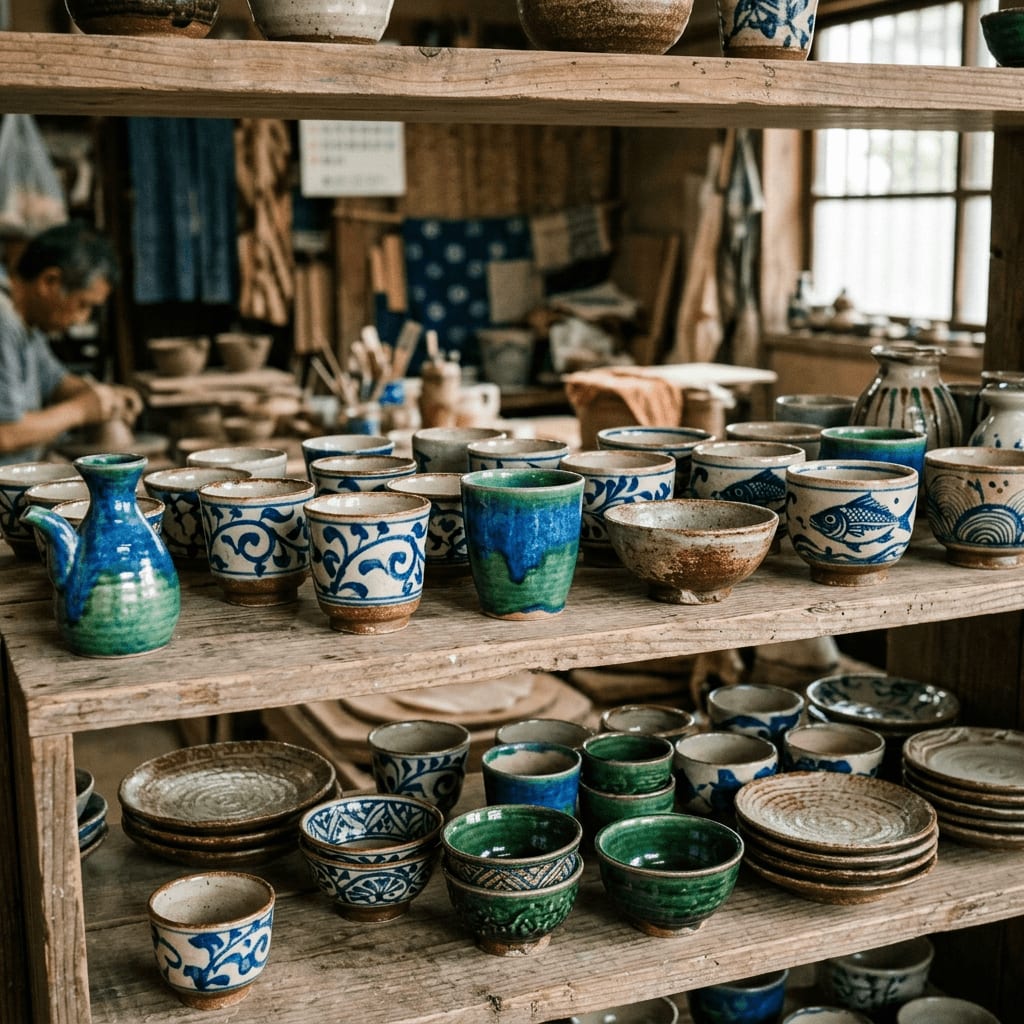
In 1682, the Ryukyu royal court merged three ancient kilns (Chibana, Wakuta, and Takaraguchi) onto this breezy hillside to centralize ceramic craftsmanship. Spared from World War II bombing, Tsuboya has produced Yachimun (Okinawan pottery) continuously for over 340 years:
- The Climbing Kiln (Fe-nu-kama) & Tsuboya Pottery Museum: For 350 JPY (280 JPY with your monorail pass), the museum explains how potters craft unglazed Ara-yachi jars (used for aging Okinawan Awamori) and glazed Jo-yachi tableware painted with cobalt waves and tropical fish.
- The Southern Suujigwa Alleys: After browsing the 400-meter stone-paved main street (Yachimun-dori), duck into the narrow, car-free footpaths to the south to spot antique communal stone wells (Agari-nu-ka) and dozens of protective Shisa lion-dogs perched on coral walls.
3. Late Afternoon (15:30 - 18:00): Covered Arcades & Makishi Public Market
Exiting the western end of Tsuboya leads directly beneath Naha's 3-kilometer network of covered shopping arcades (Shotengai: Heiwa-dori, Ichiba-Hondori, and Mutsumi-bashi) to the First Makishi Public Market (rebuilt in a modern three-story hall in 2023, open 08:00 to 21:00, closed every 4th Sunday).
Browse the first-floor stalls stacked with electric-blue parrotfish (Irabucha), giant reef clams, and fresh sea grapes (Umibudo). If you wish, the upstairs dining hall prepares your first-floor seafood purchases to order for a 500 to 550 JPY per person cooking fee (Mochiage). For a quieter, creative vibe away from the crowds, stroll south down Ukishima-dori for indie island boutiques and freshly fried Sata Andagi brown-sugar doughnuts (120 to 150 JPY). (Read our full Okinawa Food & Soba Guide for every dish worth ordering.)
4. Evening (19:00 - 22:00): Nightlife Immersion in Retro Sakaemachi Market
When night falls, walk 10 minutes east of Kokusai-dori (or hop off at Asato Station) and step into Sakaemachi Market (栄町市場). Founded in the late 1940s, this narrow labyrinth of post-war alleys houses more than 100 tiny, family-run izakaya counters. Pull up a stool beneath red paper lanterns, raise a glass of chilled Orion draft or aged Awamori with a hearty "Karii!" (the traditional Ryukyu toast), and share sizzling Goya Champuru and handmade dumplings while a neighborhood musician plays the three-string snakeskin Sanshin.
Want to Unlock Hidden Shuri & Handwritten Sakaemachi Menus with a Resident Guide?
In Sakaemachi's retro backstreets, 95% of menus are handwritten in Japanese on wall strips, and Shuri's deepest history lives in unmarked alleys. Experience Naha at your own pace with Arnaud:
Day 2 in Naha: UNESCO Royal Gardens, Cliffside Shrine & Sunset
In 2000, UNESCO inscribed 9 sites across Okinawa under the Gusuku Sites and Related Properties of the Kingdom of Ryukyu, and 3 of those 9 World Heritage sites sit right inside Naha City: Sonohyan-utaki, Tamaudun, and the royal garden of Shikina-en (Agency for Cultural Affairs of Japan, World Heritage Register, 2026). Day 2 connects this tranquil royal retreat with Naha's maritime coast.
1. Morning (09:00 - 11:00): Shikina-en Royal Garden (UNESCO World Heritage)
Completed in 1799 as the second residence of the Ryukyu royal family and a diplomatic reception garden for Chinese imperial envoys (Sapposhi), Shikina-en (識名園) spans 4.2 hectares of spring-fed ponds, arched coral-limestone bridges, and subtropical fruit groves (admission: 400 JPY, or 320 JPY with your Yui Rail Pass; reachable in 10 minutes by taxi from Shuri Station for ~1,100 JPY or via local Bus #2, #3, #5, or #14). Remove your shoes to step inside the 15-room wooden Udun palace and enjoy near-total serenity at 09:00 before any tour groups arrive.
2. Midday (11:30 - 14:30): Cliffside Naminoue Shrine & Fukushuen Chinese Garden
Head to the western coast of downtown Naha (a 12-minute walk from Asahibashi or Kencho-mae stations):
- Naminoue Shrine (Naminoue-gu, Free Admission): Meaning "Above the Waves," Okinawa's most sacred Shinto shrine perches dramatically atop a black coral cliff overlooking the East China Sea. Below the cliff lies Naminoue Beach, Naha's only urban sandy cove (great for dipping your feet, though for world-class coral snorkeling you should consult our 10 best beaches in Okinawa guide or take a fast boat to the Kerama Islands).
- Fukushuen Chinese Garden (福州園): Just 5 minutes south in the historic Kume district (where 36 families of Chinese scholars and navigators settled in 1392), this classical Fuzhou landscape garden features waterfalls, covered lake walkways, and a tea pavilion behind a waterfall (admission: 200 JPY daytime 09:00-18:00; 300 JPY for evening light-up 18:00-21:00).
3. Afternoon & Sunset (15:00 - 18:30): Choose by Weather
- Option A (Sunny & Breezy): Sunset & Ocean Hot Springs at Senagajima Island: Hop on the TK02 Umikaji Liner bus from Kencho-mae or Naha Airport (20 minutes, 250 JPY) across the causeway to Senagajima Umikaji Terrace. Watch planes touch down over turquoise lagoon waters while enjoying fresh mango desserts or soaking in the cliffside ocean-view thermal baths at Ryukyu Onsen Senagajima Hotel (1,500 to 2,000 JPY day-pass entry).
- Option B (Hot Midday or Rain): Okinawa Prefectural Museum (OkiMu): Ride the Yui Rail to Omoromachi Station and visit the fortress-like OkiMu (permanent history & nature collection: 530 JPY, or 420 JPY with your Yui Rail Pass). If martial arts history fascinates you, pair this with our deep dive into the origins of Karate in Okinawa.
Where to Stay in Naha for Effortless Monorail Access
To make your 1 or 2 days in Naha completely seamless, book a hotel within a 5-minute walk of one of four central Yui Rail stations:
- Makishi or Asato Stations: My top recommendation for culture and food lovers. You are steps away from Tsuboya pottery alleys, the covered market arcades, and Sakaemachi night izakayas, and just 9 minutes by monorail from Shuri.
- Kencho-mae or Miebashi Stations: Ideal if you plan to walk to Tomari Port (Tomarin) the next morning to catch a ferry to Zamami or Tokashiki (or join a winter excursion for Okinawa humpback whale watching).
- Omoromachi Station: Modern, wide boulevards right next to the OkiMu Museum and downtown car rental counters, perfect for picking up your vehicle (with your 1949 Geneva IDP) as you launch your 7-day Okinawa road trip.
(See our complete breakdown of neighborhood pros, cons, and hotel tiers in our Where to Stay in Okinawa Guide.)
In strict compliance with Japan's Travel Agency Act (Ryokogyo-ho) and Road Transportation Act (Doro Unso-ho), Breizh & Ryukyu invoices exclusively for private cultural guiding and bilingual interpretation fees. All on-site personal expenses (monorail tickets, castle and garden admissions, food, and drinks) are settled directly by travelers with each venue. When driving outside Naha, remember that Japan enforces an absolute 0.00 g/l zero-alcohol limit.
Related Okinawa Field Guides
Frequently Asked Questions About Visiting Naha
How many days do you need in Naha, Okinawa?
Plan at least 1 full day and 1 evening to experience Naha historical core: Shuri Castle, the 340-year-old Tsuboya pottery district, Makishi Public Market, and the retro night alleys of Sakaemachi. Spending 2 full days is ideal to add the UNESCO-listed Shikina-en Royal Garden, the cliffside Naminoue Shrine, Fukushuen Chinese Garden, and the Okinawa Prefectural Museum (OkiMu) at a relaxed pace.
Should I rent a car as soon as I land at Naha Airport?
No, picking up a rental car immediately for a stay inside Naha is the number one logistical mistake! Central Naha suffers from rush-hour congestion, and downtown hotels charge 1,500 to 2,500 JPY ($10 to $17 USD) per night for parking. Explore Naha for 1 or 2 days entirely on foot and via the elevated Yui Rail monorail (800 JPY for a 24h pass or 1,400 JPY for a 48h pass), then pick up your rental car only when heading north.
Is Shuri Castle worth visiting in 2026 during its reconstruction?
Yes, unconditionally. Following the 2019 fire, the reconstruction of the Seiden main palace hall (scheduled for completion in autumn 2026) was designed as a transparent living museum. For a 400 JPY admission fee (320 JPY with a Yui Rail day pass), visitors walk through a three-story glass-walled viewing deck to watch master carpenters and lacquer artisans restore the royal palace.
Where should I eat at night in Naha to avoid Kokusai-dori tourist traps?
Skip the loud neon restaurants with street touts directly on Kokusai-dori avenue. Instead, ride the Yui Rail to Asato Station and step inside Sakaemachi Market, or wander the side arcades of Heiwa-dori and Ukishima-dori. In Sakaemachi, over 100 tiny family-run izakayas serve authentic Goya Champuru, braised Rafute pork, and aged Awamori alongside live Sanshin folk music for 2,500 to 4,000 JPY ($17 to $27 USD) per person.
What are the best things to do in Naha on a rainy day?
During tropical downpours, head to the Okinawa Prefectural Museum & Art Museum (OkiMu, 10 minutes from Omoromachi Station, 530 JPY), stroll beneath the 3 kilometers of covered shopping arcades (Shotengai) linking Makishi, Ichiba-Hondori, and Heiwa-dori, visit the Tsuboya Pottery Museum (350 JPY), or enjoy an indoor evening food tour in Sakaemachi covered market.
- Okinawa Urban Monorail Inc. (Yui Rail), Fares, 24h/48h QR Passes & Partner Attraction Discounts, retrieved November 2026, https://www.yui-rail.co.jp/en/
- Shurijo Castle Park (Okinawa Churashima Foundation), Seiden Reconstruction Schedule & Visitor Information, retrieved November 2026, https://oki-park.jp/shurijo/en/
- Naha City Cultural Property Division, UNESCO World Heritage Sites in Naha (Shikina-en, Tamaudun, Sonohyan-utaki) & Tsuboya Pottery Museum, retrieved November 2026, https://www.city.naha.okinawa.jp/
- First Makishi Public Market Official Portal, Floor Guide & Mochiage Cooking System, retrieved November 2026, https://www.makishi-public-market.jp/

About the Author: Arnaud
Resident in Nago (northern Okinawa) since 2018, Arnaud is a bilingual local private guide and the founder of Breizh & Ryukyu. He crafts tailor-made journeys across the archipelago, bridging Breton roots with deep Ryukyuan cultural heritage.