
Make Breizh & Ryukyu your preferred source on Google
Get our newest Okinawa stories, travel tips and itineraries featured directly in your search results.
Choosing where to stay in Okinawa is one of the most strategic decisions of your entire trip. Unlike major mainland Japanese cities such as Tokyo or Kyoto, where dense rail networks let you sleep in almost any district and cross town in 20 minutes, Okinawa Main Island (Okinawa Hondo) stretches over 106 kilometers (66 miles) from north to south and has zero train lines outside Naha's urban monorail.
Picking the wrong hotel base can quickly turn a dream subtropical vacation into an exhausting road trip stuck in rush-hour traffic bottlenecks along coastal Route 58.
Living in Okinawa since 2018 and guiding travelers across the archipelago year-round from my home base in Nago, I have put together this unfiltered resident guide to the best areas and neighborhoods to stay in Okinawa, their pros and cons, hotel styles, and how to structure your itinerary for maximum enjoyment.
- The 2-Base Split Rule (5 to 8 Days): Never commute daily from Naha to the far north. Spend 2 nights in Naha (car-free culture, dining, and Kerama ferries) followed by 3 to 5 nights in the North (Nago or Motobu) or Central Coast.
- Three Distinct Regional Vibes: Choose Naha for walkability, history, and nightlife; the Central West Coast (Chatan, Yomitan, Onna) for full-service beach resorts; and Northern Okinawa (Nago, Motobu, Yanbaru) for untamed nature, quiet beaches, and authentic village charm.
- Parking & Rental Car Timing: Downtown Naha and Onna resorts charge 1,000 to 2,000 JPY/night for parking, whereas Northern Okinawa parking is almost always free. Pick up your rental car only when leaving Naha!
The Golden Rule: Should You Change Hotels or Keep One Base in Okinawa?
In 2026, regional traffic data from Okinawa Prefecture and the Okinawa Convention & Visitors Bureau confirms that driving the 106-kilometer length of Okinawa Main Island takes 90 to 135 minutes one way between Naha and Motobu/Nago (and over 2.5 hours to Cape Hedo), making a two-hotel split stay the single smartest move for any trip lasting 5 days or more.
Before looking at individual neighborhoods, one question comes up in nearly every conversation I have with travelers: can you explore all of Okinawa from a single hotel? Here is how to decide based on your trip length:
Short Stay: 1 Single Base
Keep one single home base so you do not lose time packing and checking in twice. Choose Naha if you are traveling without a car, or the Central West Coast (Chatan, Yomitan, or Onna) if you have a rental car and our Okinawa Car Rental Agencies & Airport Traps Guide.
Split Stay: 2 Strategic Bases
- Stage 1 (2 nights in Naha/South): Explore Shuri Castle, Tsuboya pottery district, evening izakayas without driving, and a day ferry to the Kerama Islands.
- Stage 2 (3 to 5 nights in the North: Nago/Motobu): Discover wild beaches, Churaumi Aquarium, UNESCO Yanbaru forests, and craft distilleries.
Extended Stay: 3 Bases or Outer Islands
Enjoy 3 stages on the main island (Naha for urban culture, Onna/Yomitan for beachfront resort relaxation, then the far North in Yanbaru), or pair our 7-day Okinawa Main Island itinerary with a direct flight to Miyakojima or Ishigaki.
1. Naha & Southern Okinawa: Best Car-Free Base for Culture & Nightlife
In 2026, urban transit data from the Okinawa Urban Monorail (Yui Rail) shows that Naha's 19-station rail corridor connects Naha Airport (OKA) to downtown in just 11 to 16 minutes (290 to 340 JPY) and reaches Shuri Castle in 27 minutes, making the prefectural capital the undisputed champion for car-free stays, Ryukyu royal history, and vibrant local dining.
Who Should Stay in Naha?
- Travelers visiting Okinawa without a rental car.
- Food lovers who enjoy strolling through lively backstreets in the evening, tasting Okinawan soba and neighborhood izakaya specialties, and sipping aged Awamori without worrying about Japan's strict 0.00 g/L driving laws.
- History buffs and martial arts practitioners training at traditional dojos in Shuri and Naha or joining our Shuri Royal Heritage & Tsuboya Pottery private walking tour.
- First-night arrivals or final-night departures needing effortless 15-minute access to Naha Airport.
The 4 Best Micro-Neighborhoods in Naha:
- Miebashi / Tomari (Most Versatile Hub): A 7-minute walk from lively Kokusai Dori street and only 5 minutes on foot from Tomarin Maritime Terminal (Tomari Port), where municipal ferries and high-speed boats depart for Tokashiki, Zamami, and Aka (see our complete Kerama Islands guide and winter whale watching guide).
- Kencho-mae / Kokusai Dori (Heart of the Action): Right in the center of downtown shopping, the covered arcades of Makishi Public Market, Tsuboya Yachimun Street, and lively nightlife.
- Asahibashi (Regional Bus Hub): Ideal if you plan to explore Okinawa by public bus. Asahibashi Monorail Station connects directly via elevated walkway to the Naha Bus Terminal, where express and regional buses depart across the island.
- Omoromachi / Naha Shintoshin (Modern & Car Rental Hub): A spacious, contemporary district lined with shopping malls, the Okinawa Prefectural Museum, and major car rental offices. Very convenient for picking up or dropping off a vehicle without driving through downtown congestion.
2. Central West Coast (Chatan, Yomitan, Onna): Beach Resorts & Sunsets
In 2026, hospitality data from Okinawa Prefecture indicates that over 60% of the island's four- and five-star beachfront resort rooms are concentrated along the Central West Coast between Chatan, Yomitan, and Onna Village, roughly 40 to 75 minutes north of Naha.
Chatan & American Village
Built around a lively oceanfront entertainment and shopping complex with American-inspired architecture, Chatan is a favorite with families and couples who want walkable evening dining.
- Pros: Spectacular East China Sea sunsets, dozens of trendy cafes, oceanfront bars, and a pleasant pedestrian boardwalk along Sunset Beach and Araha Beach.
- Cons: Very Americanized atmosphere, less traditional Ryukyu charm, and heavy weekend traffic along Route 58.
Yomitan Village
Just north of Chatan, Yomitan offers a much more authentic balance between Ryukyu craftsmanship and dramatic coastal scenery.
- Pros: Home to the famous potters' village (Yachimun no Sato), Cape Zanpa cliffs, Zakimi Castle (UNESCO), and lovely natural coves like Nirai Beach.
- Stays: Features iconic upscale properties (Hoshinoya Okinawa, Hotel Nikko Alivila) alongside peaceful boutique guesthouses tucked into the greenery.
Onna Village
A long, scenic coastal ribbon lined with prestigious beachfront resort hotels (Halekulani Okinawa, ANA InterContinental Manza Beach, Sheraton Sun Marina).
- Pros: Lifeguarded white-sand resort beaches, water sports, infinity pools, and immediate access to Cape Maeda (Blue Cave snorkeling).
- Cons: High summer rates, paid hotel parking (1,500-2,500 JPY/night), and independent restaurants often require driving (a car is essential).
3. Northern Okinawa (Nago & Motobu): Wild Nature, Yanbaru & Authenticity
In 2026, Northern Okinawa (known historically as Yanbaru) encompasses the 42,900-hectare UNESCO-listed Yanbaru National Park and the scenic Motobu Peninsula, offering travelers 100% free hotel parking at nearly every property and nightly rates 25% to 40% lower than comparable accommodations on the Onna resort coast. This is where Okinawa's wild, unhurried heart beats, and it is right here in Nago that I chose to make my home.
Who Should Base Themselves in the North?
- Lovers of subtropical rainforest hikes, river waterfalls, and unspoiled natural beaches (discover our ranking of the 10 best beaches in Okinawa).
- Travelers visiting Okinawa Churaumi Aquarium, Nakijin Castle Ruins (UNESCO), and the bridge-connected northern islands (Kouri-jima, Sesoko-jima, and Yagaji-jima).
- Anyone seeking peace, starry skies, and genuine local neighborhood life far from tour buses.
Where to Stay in Northern Okinawa:
- Nago City (The Strategic Northern Crossroads): Offers excellent budget-friendly modern business hotels (6,000 to 15,000 JPY / ~$40-$100 USD), a vibrant municipal market, the Orion Happy Park brewery, and authentic local izakayas where you dine alongside residents without a single tour group in sight.
- Motobu Peninsula & Bise Village (Pure Island Charm): Sleep steps away from the famous Bise Fukugi Tree Street, where traditional wooden houses with red-tile roofs and coral stone walls are sheltered from sea winds by thousands of centuries-old Fukugi trees, facing Emerald Beach and Ie-jima Island.
- Higashi, Ogimi & Kunigami (Deep Yanbaru Rainforest): For total nature immersion in Japan's famous longevity villages. You will find intimate eco-lodges, family-run minshuku guesthouses, and riverside glamping sites.
4. Quick Comparison Table of Okinawa Neighborhoods & Bases
In 2026, comparing Okinawa's six main lodging zones side by side highlights a clear trade-off between car-free convenience in the south and natural space in the north (rates shown for a double room for 2 adults, using 1 USD ≈ 150 JPY / 1 EUR ≈ 160 JPY):
| Area / Town | Atmosphere | Without a Car? | Avg Nightly Budget (2p) | Best For... |
|---|---|---|---|---|
| Naha (Downtown & Port) | Urban, historic, lively | ⭐⭐⭐⭐⭐ Perfect | 6,000 - 14,000 JPY (~$40-$95 / ~38-88€) | Culture, izakayas, shopping, Kerama ferries |
| Chatan (American Village) | Beachfront, trendy, festive | ⭐⭐⭐ Possible by bus | 12,000 - 25,000 JPY (~$80-$165 / ~75-155€) | Nightlife, sunsets, families |
| Onna Village | Large resorts, white sand | ⭐ Difficult (Shuttle only) | 20,000 - 60,000 JPY (~$135-$400 / ~125-375€) | Honeymoons, beach relaxation, luxury comfort |
| Yomitan Village | Pottery crafts, coastal calm | ⭐⭐ Car required | 10,000 - 35,000 JPY (~$65-$235 / ~62-220€) | Couples, pottery lovers, zen atmosphere |
| Motobu & Bise | Traditional villages, wild coast | ⭐⭐ Not recommended | 9,000 - 30,000 JPY (~$60-$200 / ~56-190€) | Churaumi Aquarium, Bise trees, secret beaches |
| Nago City | Local hub, friendly, nature gateway | ⭐⭐ Car preferred | 6,000 - 18,000 JPY (~$40-$120 / ~38-112€) | Yanbaru hikes, local markets, value stays |
5. Which Type of Accommodation Should You Choose in Okinawa?
In 2026, Okinawa's hospitality landscape spans three distinct lodging categories, ranging from ultra-efficient Japanese urban business hotels at 6,000 JPY/night to restored century-old wooden Ryukyu homesteads and five-star oceanfront resorts:
1. Modern Japanese Business Hotels (Naha & Nago)
Trusted Japanese chains such as Daiwa Roynet, Richmond Hotels, Vessel Hotels, and Comfort Hotel offer compact but clinically spotless rooms with high-grade mattresses, fast Wi-Fi, coin laundries, and often large indoor or rooftop public hot baths (Daiyokujo).
- Price Range: 6,000 to 13,000 JPY (~$40 to $85 USD / ~38 to 80 EUR) per double room.
- Our Verdict: Unbeatable value for money if you spend your days out exploring the island.
2. Private Restored Ryukyu Folk Houses (Kominka / Machiya)
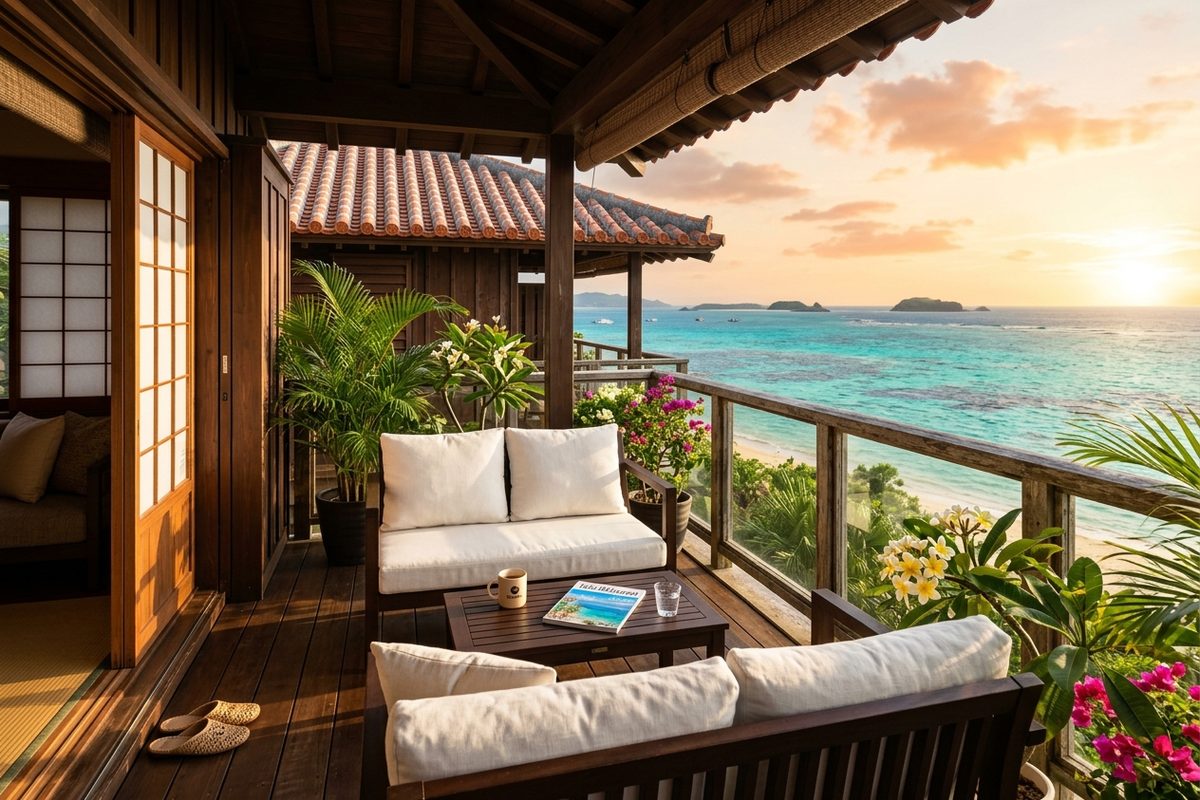
An increasing number of historic wooden Ryukyu homes enclosed by coral-stone walls and guarded by ceramic Shisa lions have been lovingly restored with modern air conditioning, fragrant tatami mats, thick futons, and lush tropical gardens.
- Where to Find Them: In Bise Village, Motobu, Nakijin, Yomitan, or on peaceful Hamahiga Island.
- Price Range: 18,000 to 45,000 JPY (~$120 to $300 USD / ~110 to 280 EUR) for the entire house (fantastic value for families or groups of 3 to 5).
- Our Verdict: An unforgettable way to soak up the soul of old Okinawa, listen to evening cicadas, and sip cold Sanpincha jasmine tea on the wooden veranda (Engawa).
3. Full-Service Beachfront Resorts (Onna, Yomitan & Motobu)
Equipped with private lifeguarded lagoons, indoor and outdoor pools, and full spas, these complexes suit travelers who want to unwind without leaving the property.
- Our Verdict: Ideal for 2 or 3 nights of pampering in the middle or at the end of your trip. Watch out for ancillary surcharges: pricey in-house restaurants, nightly parking fees (1,500-2,500 JPY), and extra charges for beach umbrellas and loungers.
6. Practical Tips for Booking Smart in Okinawa (Peak Weeks & Typhoons)
In 2026, seasonal hotel rate tracking across Okinawa Prefecture shows that nightly room prices can double or triple during three domestic Japanese holiday windows, while booking 4 to 6 months ahead and understanding typhoon cancellation policies protects both your budget and peace of mind.
⚠️ Watch Out for Japan's 3 Peak Holiday Periods
Hotel and rental car prices surge dramatically during three critical domestic holiday windows:
- Golden Week (late April to early May, April 29 to May 5).
- Summer School Holidays & O-Bon (mid-July through late August).
- Japanese New Year (December 29 to January 3).
If your trip overlaps with these dates, book your accommodations and rental car at least 4 to 6 months in advance. For the best balance of warm 26°C (79°F) ocean water and moderate hotel rates, read our Okinawa weather and seasons guide and our complete Okinawa travel budget guide.
🌀 Typhoon Cancellation Policies (July to October)
Okinawa can experience tropical typhoons between July and early October. Almost all hotels in Okinawa apply a fee-free force majeure cancellation waiver if flights into Naha Airport (OKA) or ferries to the outer islands are officially cancelled by airlines or maritime operators.
Resident Tip: Always choose flexible cancellation rates when booking for late summer, and keep official airline flight cancellation certificates for your hotel and travel insurance.
In strict compliance with the Japanese Travel Agency Act (Ryokogyoho) and Road Transport Act (Doro Unsoho), Breizh & Ryukyu operates exclusively as a private local guide and cultural interpreter. We never bundle or sell hotel rooms, transport, or entrance tickets as all-inclusive packages: all accommodations, meals, and site admissions are booked and paid directly by travelers to the respective establishments. During our private guided tours, island transport takes place either in your own rental car (requiring a valid 1949 Geneva IDP or official JAF translation, with strict 0.00 g/L zero-alcohol compliance) or via a licensed green-plate transport partner.
Frequently Asked Questions About Where to Stay in Okinawa
Should I stay in one hotel or split my stay across Okinawa?
If your trip exceeds 4 or 5 days, splitting your stay into two strategic bases is strongly recommended: for example, 2 nights in Naha for Ryukyu cultural heritage and Kerama Island ferries, followed by 3 to 4 nights in Central or Northern Okinawa (Nago or Motobu). Okinawa Main Island stretches over 106 kilometers from north to south, and morning and evening rush-hour bottlenecks on Route 58 waste valuable hours if you commute daily from a single hotel.
Which neighborhood should I choose in Naha without a rental car?
Without a car, stay within walking distance of a Yui Rail monorail station. Choose Miebashi Station for a 5-minute walk to Tomarin Ferry Terminal (departures to the Kerama Islands) and 7 minutes to Kokusai Dori; Kencho-mae Station to be right in the shopping and dining action; Asahibashi Station for direct access to Naha Bus Terminal; or Omoromachi Station for a quieter modern district with car rental desks.
How much should I budget per night for a hotel in Okinawa?
In 2026, a spotless modern Japanese business hotel in Naha or Nago costs between 6,000 and 13,000 JPY (~$40 to $85 USD / ~38 to 80 EUR) per night for two guests. Beachfront resort hotels in Onna or Motobu range from 18,000 to 45,000 JPY (~$120 to $300 USD / ~110 to 280 EUR) depending on the season. Private restored Ryukyu traditional houses (Kominka) or coastal villas cost between 25,000 and 60,000 JPY (~$165 to $400 USD / ~155 to 370 EUR) per night.
Are hotel parking lots free in Okinawa?
In Northern Okinawa (Nago, Motobu, Yanbaru) and rural coastal villages, hotel parking is almost always 100% free. Conversely, in downtown Naha and at large beachfront resort hotels along the west coast (Onna and Chatan), parking is almost always charged separately at 1,000 to 2,000 JPY (~$6.50 to $13 USD) per night. Always verify parking fees before booking if you are renting a car.

Pair Your Okinawa Bases with Private Guided Experiences
Once your Naha and Northern Okinawa bases are set, let me guide you off the beaten path: royal heritage walks in Shuri, subtropical rainforest treks in UNESCO Yanbaru, and authentic evenings in local neighborhood izakayas.