
Make Breizh & Ryukyu your preferred source on Google
Get our newest Okinawa stories, travel tips and itineraries featured directly in your search results.
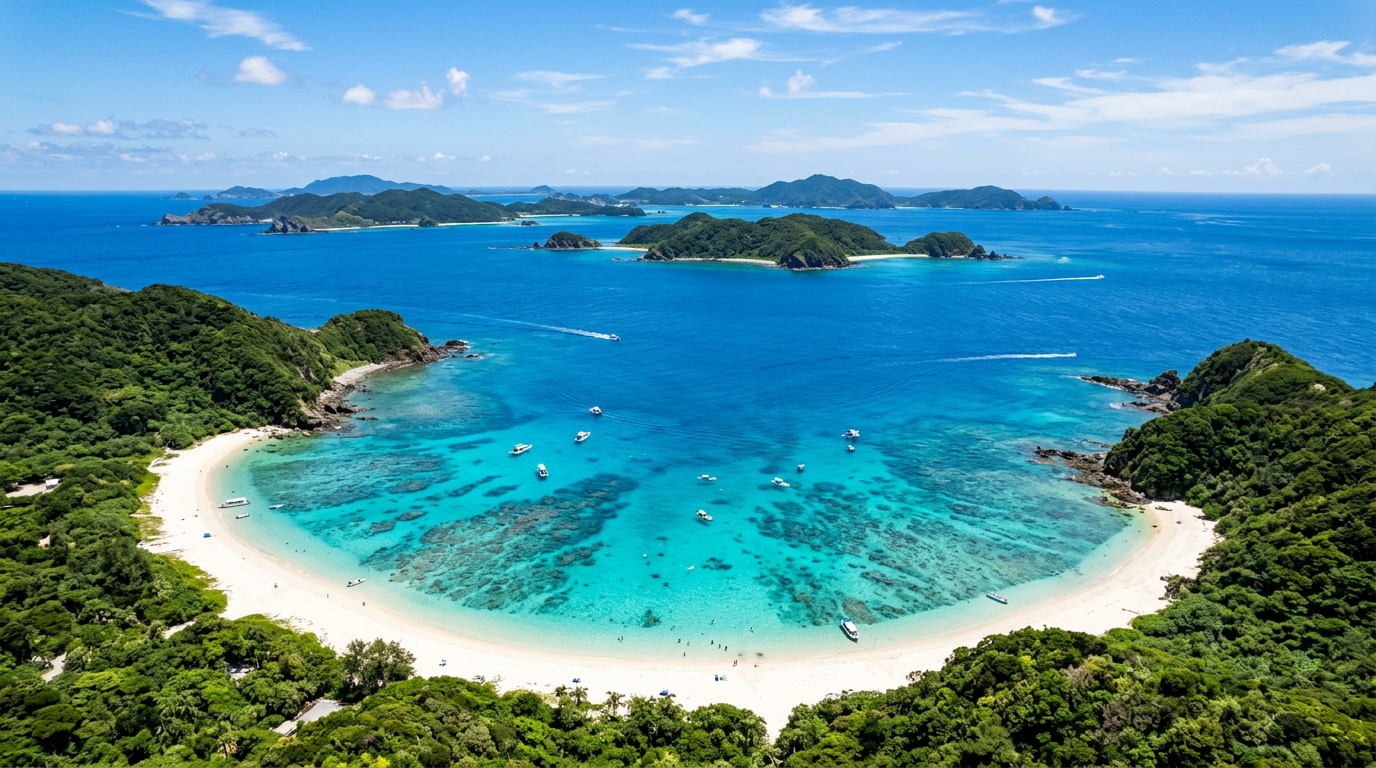
Floating just 30 to 40 kilometers (19 to 25 miles) west of Naha across the East China Sea, the Kerama Islands (Kerama Shoto) look like a tropical postcard come to life. Their coral sand seabeds are so pure and their water gradients so luminous that Japanese oceanographers coined a special name for this shade of turquoise: the "Kerama Blue".
Designated as Kerama Shoto National Park in 2014 by the Ministry of the Environment of Japan, the archipelago protects 248 species of reef-building hard corals (roughly 60% of all coral species found in Japan), hundreds of tropical fish species, and one of East Asia's highest coastal densities of green and hawksbill sea turtles. On paper, it is the ultimate island escape for anyone staying in Naha without taking another flight.
Yet a candid reality check is essential. If you head to the Keramas unannounced, copying a generic forum itinerary or following advice from a distant travel agency that has never set foot in Okinawa, your dream island day can quickly turn into frustration at the ferry dock.
Based in Okinawa since 2018, here is my complete, unfiltered resident guide to visiting Tokashiki, Zamami, and Aka: how to pick the island that matches your pace, secure your municipal ferry seats without stress, outsmart summer crowds, and experience the finest jewels of the Kerama Blue.
- Three Distinct Island Personalities: Choose Tokashiki (35 min by fast boat) for dramatic mountain lookouts and Aharen Lagoon, Zamami (50 min) for village charm and shore-entry sea turtles at Ama Beach, or Aka (50 min) for untouched reefs and wild Kerama deer.
- Strict 60-Day Ferry Window: All ferries depart from Naha's Tomari Port (Tomarin). Online booking opens 55 to 60 days prior on the municipal portals of Zamami Village and Tokashiki Village; high-speed boats sell out weeks ahead from April to October.
- The Overnight Advantage: Over 80% of summer visitors leave on the 4:30 PM return ferry. Spending just one night on Zamami or Aka gives you empty beaches at sunset and private early-morning swims with sea turtles before 10:00 AM.
As I explain in detail in my guide to visiting Okinawa without a car, the Kerama Islands face intense tourist pressure from April through October.
Nearly every overseas tour operator and guidebook directs travelers to the exact same Tomarin terminal in Naha to board the same morning ferry toward Furuzamami or Aharen. Here is what happens on the ground during peak summer:
- High-speed boats sell out weeks in advance: Without booking right when the 60-day reservation window opens, you will be left on the pier in Naha.
- Saturated main beaches: Tightly packed rows of rental beach umbrellas, constant shuttle bus traffic, and dense crowds along the first 100 meters of shoreline.
- Accommodation scarcity: Family-run guesthouses (minshuku) book out 3 to 4 months ahead of July and August, with nightly rates climbing sharply.
Tokashiki vs. Zamami vs. Aka: Which Kerama Island Should You Choose?
In 2026, parkland surveys by the Ministry of the Environment of Japan (Kerama Shoto National Park Management Data) cover more than 30 islands and islets across 90,475 hectares of protected marine area, yet only four islands are inhabited: Tokashiki (~700 residents), Zamami (~600 residents), Aka (~260 residents), and tiny Geruma (~60 residents, linked to Aka by a bridge). For your first visit, your choice comes down to the three main islands:
| Comparison Criteria | 🏝️ Tokashiki Island | 🐢 Zamami Island | 🦌 Aka Island |
|---|---|---|---|
| Island Profile | Largest island with steep, dramatic mountain ridges | Perfect balance, lively and welcoming village hub | Wildest, quietest, and most unhurried island |
| Fast Boat from Naha | 35 min (Marine Liner Tokashiki) | 50 min (Queen Zamami) | 50 min (Queen Zamami) |
| Standard Car Ferry | 70 min (Ferry Tokashiki) | 90 to 120 min (Ferry Zamami) | 90 to 120 min (Ferry Zamami) |
| Signature Beaches | Aharen Beach, Tokashiku Beach | Furuzamami Beach, Ama Beach | Nishibama Beach, Hizushi Beach |
| Coral Reef Snorkeling | ⭐⭐⭐⭐ (Aharen lagoon reefs) | ⭐⭐⭐⭐⭐ (Spectacular drop-off at Furuzamami) | ⭐⭐⭐⭐⭐ (Pristine staghorn corals at Nishibama) |
| Sea Turtle Sightings | ⭐⭐⭐⭐ (Sheltered Tokashiku Bay) | ⭐⭐⭐⭐⭐ (Ama Beach seagrass beds at high tide) | ⭐⭐⭐ (Regular sightings along coastal reefs) |
| Getting Around | Village shuttle bus or rental car/scooter required | E-bike, 300 JPY municipal bus, or walking | On foot or standard bicycle (flat coastal roads) |
| Overall Vibe | Day-trip friendly, sweeping elevated panoramas | Sociable, cozy cafes, warm island village life | Total serenity, free-roaming deer, zero resort clutter |
| Best For | Travelers wanting big lagoon views in 1 day | Families, snorkelers, and sea turtle enthusiasts | Seekers of pure silence, raw nature, and diving |
1. Tokashiki Island: Cliffside Vistas & the Electric Lagoon of Aharen
In 2026, municipal transit data from Tokashiki Village confirms that Tokashiki is the largest (15.3 km²) and closest of the main Kerama islands, reached in just 35 minutes by the Marine Liner Tokashiki high-speed ferry from Naha Tomari Port. With steep hills blanketed in subtropical forest rising over 220 meters (720 feet) above the sea, it delivers the most dramatic coastal topography in the archipelago.
What Makes Tokashiki Unique:
- Aharen Beach: An 800-meter crescent bay of dazzling white coral sand washed by translucent turquoise water. Live coral heads begin just a few strokes from shore. At the southern tip of the beach, a paved footpath climbs to Kubandaki Observatory, rewarding you with a breathtaking elevated panorama over the entire lagoon and uninhabited Hanari Islet.
- Tokashiku Beach: Far quieter than Aharen, this sheltered cove on the west coast is framed by lush green hills. It is Tokashiki's primary sea turtle sanctuary, where resident green and hawksbill turtles feed peacefully on the sandy seafloor.
- Mountain Lookouts: Because the island's spine is high, viewpoints such as Teruyama Observatory and Aka-ma-yama offer sweeping views over the surrounding Kerama straits glistening in the sun.
How to Get Around Tokashiki:
Because of the steep gradients and winding mountain roads between the port and the beaches, never rent a standard non-electric bicycle on Tokashiki. When your boat docks at Tokashiki Port, local village shuttle buses and private beach vans wait right on the pier to carry passengers across the ridge to Aharen Beach in 15 minutes (approx. 400 JPY / ~$2.70 USD one-way per adult, paid in cash). If you want total freedom to visit both Tokashiku and the mountain lookouts, rent a compact car or scooter near the port, but inventory is tiny: book well ahead of your crossing.
2. Zamami Island: Heart of the Kerama Blue & Sea Turtle Sanctuary
In 2026, visitor statistics from Zamami Village rank Zamami Island as the most popular destination in Kerama Shoto National Park, anchored by two two-star Michelin Green Guide Japan beaches (Furuzamami and Ama Beach) within a 20-minute walk of the main harbor. Its compact port village radiates authentic island warmth, with quiet coral-walled lanes, blooming hibiscus, friendly local eateries, and welcoming dive shops.
Top Highlights on Zamami:
- Furuzamami Beach: Awarded two stars in the Michelin Green Guide Japan, this iconic beach offers an immediate snorkeling thrill. Unlike flat lagoons where you have to swim far offshore to find coral, the seabed at Furuzamami slopes steeply just 3 to 4 meters from the water's edge: you float straight over a vibrant coral drop-off teeming with clownfish, parrotfish, and electric-blue damselfish.
- Ama Beach: Located a 20-minute coastal walk west of the village, this calm, shallow bay is ideal for families. Its secret lies in the dense underwater meadows of marine eelgrass growing in shallow water. Around high tide, wild green sea turtles swim in to graze on the seagrass, often in water barely 1.5 meters deep. Floating quietly alongside a feeding turtle in its natural habitat is pure magic.
- Sunset at Takatsukiyama & Uninhabited Islets: After a day in the water, hike or ride up to Takatsukiyama Observatory or Kaminohama to watch the sun sink into the East China Sea. During the day, tiny water taxis also ferry snorkelers in 5 minutes from Zamami beach to the uninhabited sandbar islets of Gahi and Agenashiku (approx. 1,500 to 2,000 JPY / ~$10-$13 USD round-trip).
How to Get Around Zamami:
Zamami Village and Ama Beach are an easy, flat 15-to-20-minute walk from the ferry pier. To cross the hill to Furuzamami Beach or climb to the northern whale lookouts (see our Okinawa winter whale watching guide), the road climbs steeply: either rent an electric-assist bicycle in the village (approx. 2,500 to 3,500 JPY / ~$16-$23 USD per day) or hop on the blue municipal shuttle bus (300 JPY / ~$2 USD per ride) linking the port, Furuzamami, and Ama Beach.
3. Aka Island: Untouched Reefs, Quiet Lanes & Wild Ryukyu Deer
In 2026, demographic and biodiversity records from Zamami Village (which administers Aka, Geruma, and Fukaji) show that Aka Island (Aka-jima) is home to fewer than 300 permanent residents and roughly 200 protected wild Kerama deer, with zero high-rise hotels or commercial resort strips. If you want to escape crowds and experience an unspoiled Japanese island where time slows to a crawl, Aka is unforgettable.
The Magic of Aka Island:
- Nishibama Beach (Kitahama): Stretching along the northeastern shore, this 1-kilometer ribbon of powdery white sand faces water of surreal clarity. Because it receives a fraction of Furuzamami's foot traffic, its shallow staghorn and brain coral gardens remain among the healthiest in the entire archipelago. A wooden viewing deck lets you admire the kaleidoscope of blues before you even step into the water.
- Wild Ryukyu Deer (Kerama-jika): Introduced from Kyushu in the 17th century during the Ryukyu Kingdom era, these small dark-furred deer evolved in isolation and are designated as a National Natural Monument of Japan. Remarkably, they are strong ocean swimmers that cross the channels between islands! In the late afternoon, you will regularly spot them strolling peacefully down Aka's village lanes and grazing along the beach.
- Aka-Ohashi Bridge to Geruma & Fukaji: This soaring concrete arch bridge spans the turquoise strait linking Aka to the neighboring islands of Geruma and Fukaji. Pedaling across the bridge with the sea breeze in your face while spotting sea turtles swimming 20 meters directly below the bridge deck is a highlight of any trip to Okinawa.
How to Get Around Aka:
Because the coastal road between Aka Port, the village, and Nishibama Beach is relatively gentle, a classic bicycle is king on Aka. Several small shops near the port rent standard bikes for 1,000 to 1,500 JPY (~$6.50-$10 USD) per day. Always pack plenty of drinking water and snacks before heading to the beach, as shops and lunch spots on Aka are very limited.
How to Book the Kerama Islands Ferry from Naha (60-Day Rule)
In 2026, municipal maritime schedules published by Zamami Village and Tokashiki Village set online ticket reservations to open 55 to 60 days before departure, with round-trip high-speed fares ranging from 4,810 JPY (~$32 USD) for Tokashiki to 6,080 JPY (~$40 USD) for Zamami and Aka (plus the 100 JPY Kerama environmental conservation tax). All vessels depart from Tomari Port (Tomarin terminal) in central Naha, a 10-minute walk from Miebashi Station on the Yui Rail monorail.
- For Zamami & Aka: Book via the Zamami Village Official Online Reservation System (opens 2 months prior at 10:00 AM JST). Check daily schedules on the Zamami Village website. Note that Queen Zamami stops at Aka Port first (50 min) before docking at Zamami Port (60 to 70 min depending on routing).
- For Tokashiki: Book via the Official Tokashiki Ferry Portal for both Marine Liner Tokashiki and Ferry Tokashiki.
4 Resident Tips to Beat the Crowds & Protect Coral Reefs
In 2026, tourism flow analyses from the Okinawa Convention & Visitors Bureau (Visit Okinawa Japan, 2026 Island Dispersal Report) reveal that over 82% of summer visitors to the Keramas are same-day passengers who arrive at 10:00 AM and depart at 4:30 PM. If you apply these four resident strategies, you can enjoy the islands in total peace:
1. The Ultimate Hack: Spend One Night on the Island
Almost every day-tripper boards the final afternoon boat around 4:30 PM. By 5:00 PM, the island empties out completely. The beaches return to total silence, the village regains its sleepy provincial charm, the sunset is yours alone, and the night sky blazes with Milky Way stars far from Naha's city glow. The next morning, you have glassy waters and sea turtles all to yourself between 7:00 AM and 10:00 AM before the first ferry docks. Compare island guesthouses with main-island bases in our where to stay in Okinawa guide.
2. Target the Shoulder Seasons (October & Winter)
If your travel dates are flexible, skip July and August. October is the golden month: air temperatures average a balmy 27°C (81°F), the ocean stays warm at 26°C (79°F), typhoon risk drops sharply, and Japanese school holiday crowds are gone. From January through late March, water temperatures dip to 21°C (5 mm wetsuit needed for diving), and the Keramas transform into the primary breeding sanctuary for North Pacific humpback whales. Check our best time to visit Okinawa weather guide for month-by-month data.
3. Hop Between Islands on the Mitsushima Boat
Few international visitors realize you do not need to return to Naha to visit multiple Kerama islands. The small municipal launch Mitsushima connects Zamami Port and Aka Port in just 15 minutes for 300 JPY (~$2 USD), with multiple daily sailings. Furthermore, the inter-island Kerama Line service links Aka/Zamami with Aharen Port on Tokashiki (700 JPY one-way; advance reservation required by the prior afternoon).
4. Strictly Protect Corals & Sea Turtles
Kerama Shoto National Park is a fragile living ecosystem. Never use chemical sunscreens containing oxybenzone or octinoxate, which are lethal to coral larvae; wear a long-sleeve UV rashguard and 100% mineral Reef-Safe sunscreen. Never stand or rest your fins on live coral, and always keep a strict 2-to-3-meter safety buffer around sea turtles so they can surface freely to breathe. Read our full marine safety rules in The 10 Best Beaches in Okinawa.
Plan B: Exploring Okinawa Main Island Bridge-Linked Lagoons by Car
In 2026, rental car cost comparisons in Okinawa show that renting a compact Japanese car (Kei-car) at 4,500 to 6,500 JPY (~$30-$43 USD) per day is often cheaper for a couple than two round-trip high-speed ferry tickets to Zamami (12,160 JPY / ~$80 USD). If the rigid 60-day ferry booking window stresses you out, if you suffer from motion sickness, or if ferries are cancelled due to high swells, rest assured: you do not need to board a ferry to swim in breathtaking turquoise lagoons.
On Okinawa Main Island (Okinawa Hondo), spectacular satellite islands are linked to the mainland by free scenic road bridges spanning emerald lagoons:
- Sesoko Island (Motobu Peninsula): Linked by a free bridge, its 800-meter white coral sand beach and lively reef rival the finest beaches of the Keramas.
- Kouri Island: Driving across its 2-kilometer bridge suspended just above sparkling turquoise waters delivers an unforgettable sense of freedom.
- The Sacred Eastern Islands (Hamahiga, Henza, Miyagi, Ikei): Linked by the 5-kilometer Kaichu-Doro ocean causeway, offering rural Ryukyu charm and secret coves like Muruku Beach with zero tour bus crowds.
- Ie-jima Island: Reached via a calm, sheltered 30-minute car ferry from Motobu Port in the north (no 60-day scramble required for foot passengers), crowned by the volcanic pinnacle of Mount Gusuku.
To integrate both the Keramas and the northern bridge-linked islands into a seamless route, check our Okinawa 7-day road trip itinerary and our complete guide to driving and renting a car in Okinawa (IDP & JAF translation rules) and our Okinawa Car Rental Agencies & Airport Traps Guide.
In strict compliance with the Japanese Travel Agency Act (Ryokogyoho) and Road Transport Act (Doro Unsoho), Breizh & Ryukyu charges exclusively for private guiding, itinerary design, and cultural interpretation. We never package or mark up transport or ferry tickets: all municipal ferry fares, bicycle rentals, and on-site beach fees are paid directly on site by travelers to the respective operators. For private tours on Okinawa Main Island, travel takes place either in your own rental vehicle (requiring a valid 1949 Geneva IDP or official JAF translation, with strict 0.00 g/L zero-alcohol enforcement in Japan) or via a licensed green-plate transport partner.
Frequently Asked Questions About Visiting the Kerama Islands
Which Kerama island should I choose: Tokashiki, Zamami, or Aka?
It depends on your travel style. Choose Tokashiki for sweeping elevated vistas, dramatic turquoise waters at Aharen Beach, and a fast 35-minute crossing from Naha. Pick Zamami for a friendly village atmosphere, two-Michelin-star coral drop-offs at Furuzamami Beach, and swimming with wild green sea turtles at Ama Beach. Choose Aka for absolute tranquility, pristine coral gardens at Nishibama, and wild Ryukyu deer roaming free away from mass tourism.
How do I book the ferry to the Kerama Islands from Naha?
All municipal ferries depart from Tomari Port (Tomarin terminal) in central Naha. Online reservations open 55 to 60 days in advance on the official municipal portals of Zamami Village and Tokashiki Village. For high-speed boats (Queen Zamami and Marine Liner Tokashiki), booking as soon as slots open is essential between April and October, as departures sell out weeks ahead.
Can I visit the Kerama Islands as a single day trip without staying overnight?
Yes, a day trip from Naha is very popular thanks to high-speed passenger vessels: 35 minutes to Tokashiki and 50 minutes to Zamami or Aka. You depart Naha around 9:00 AM and return on the 4:30 PM or 5:00 PM boat. However, staying at least one night on the island transforms the experience once day-trippers leave at 4:30 PM.
Where can I swim with sea turtles from the beach in the Kerama Islands?
The two best shore-accessible sea turtle spots are Ama Beach on Zamami Island (where green sea turtles graze on shallow seagrass beds at high tide) and Tokashiku Beach on Tokashiki Island. Always maintain a strict safety distance of at least 2 to 3 meters and never touch or chase the turtles.
What should I do if the Kerama ferries are sold out or cancelled due to swells?
If high-speed boats are fully booked or cancelled due to open-ocean swells, rent a car on Okinawa Main Island to explore the toll-free bridge-connected islands in the North and East (Sesoko, Kouri, Hamahiga, Ikei), or take the sheltered 30-minute car ferry from Motobu Port to volcanic Ie-jima.

Explore Okinawa's Hidden Treasures with a Local Resident Guide
Whether you combine a Kerama Islands excursion with our Naha & Shuri Royal Heritage walking tour or venture north into the UNESCO rainforest on our Yanbaru Nature & Secret Coastlines tour, let us craft an authentic journey tailored to your pace.